
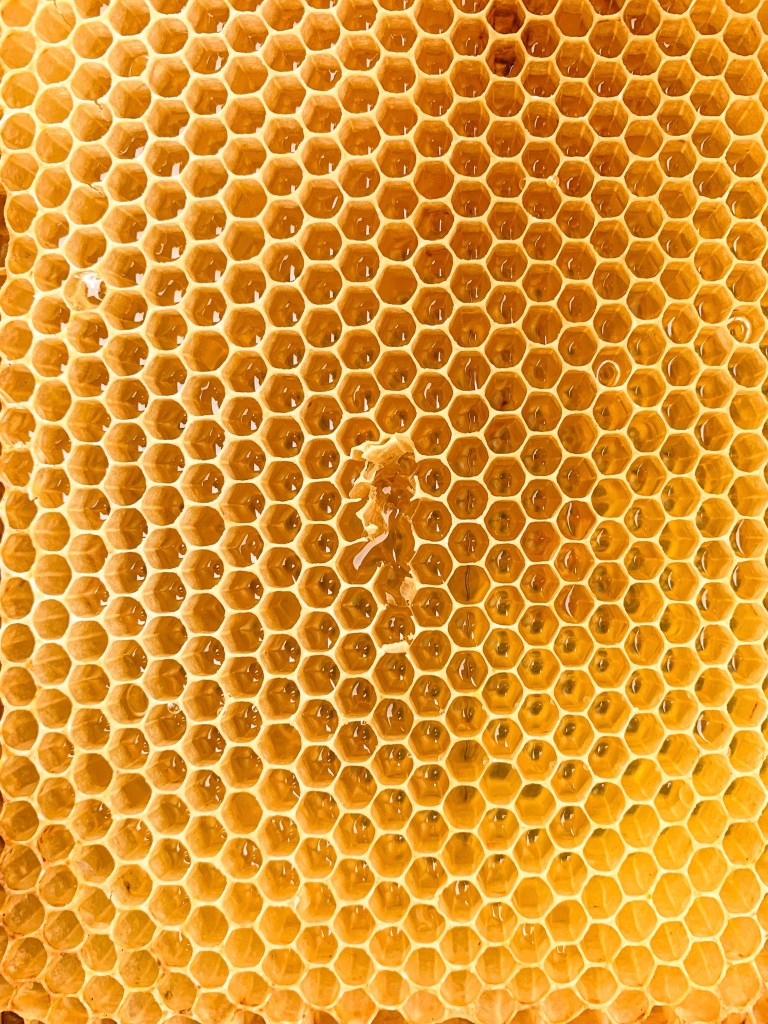
In 1922, archaeologists opening tombs in Egypt found sealed pots of honey buried alongside pharaohs thousands of years earlier. According to numerous later accounts, the honey was still edible. Whether or not any of them actually tasted three-thousand-year-old funerary honey is a detail that has gotten fuzzier with each retelling, but the underlying chemistry is not folklore at all. Honey genuinely does not spoil in any meaningful sense, and the reason is a small masterclass in how a single insect solved a food-preservation problem that humans wouldn’t crack for millennia.
Most food goes bad because microorganisms — bacteria, yeast, mold — move in, feed on it, and multiply. To spoil, food generally needs three things available to those microorganisms: moisture, a hospitable pH, and nutrients they can access. Honey manages to be almost uniquely hostile on all three counts at once, and bees didn’t design it that way for us. They designed it that way to keep their own winter food supply from rotting inside the hive.
The Moisture Trap
The single biggest factor is water content, or rather the lack of it. Ripe honey is roughly 17 to 18 percent water, which sounds like plenty until you understand the concept of “water activity” — a measure of how much of that water is actually available for microorganisms to use, as opposed to being chemically locked up. Honey’s sugar concentration is so extreme, and the sugar molecules so aggressively bind to the available water molecules, that almost none of it is left over for a bacterial or fungal cell to use. This is the same basic principle behind salting meat or making jam — sugar and salt both work by making water biologically unavailable — but honey does it more thoroughly than almost anything else in nature. Bees achieve this concentration through an almost absurdly labor-intensive process: they physically fan the wet nectar with their wings for hours, evaporating off excess water until it crosses this specific threshold, at which point they cap the cell with wax to seal it.
An Acidic, Enzyme-Laced Fortress
Even the small amount of water that remains isn’t a friendly environment. Honey’s pH typically sits between 3.2 and 4.5, acidic enough to be inhospitable to most of the bacteria that cause food spoilage, most of which prefer something closer to neutral. On top of that, bees add an enzyme called glucose oxidase to the nectar as they process it. This enzyme slowly reacts with the honey’s glucose to produce small, steady amounts of hydrogen peroxide — the same compound used as a household disinfectant — creating a low-grade antimicrobial environment that persists for as long as the honey exists. It’s a slow, self-renewing chemical defense system, built entirely from sugar and one insect enzyme.
Why Sealed Honey Beats Even Modern Preservation
What makes ancient honey specimens genuinely remarkable isn’t just that honey resists spoilage — plenty of foods can be preserved with the right technique. It’s that honey does this on its own, indefinitely, with no refrigeration, no added preservatives, and no processing beyond what bees themselves already do inside the hive. A sealed jar of honey, kept away from moisture, is chemically stable more or less forever, which is why food chemists sometimes describe it as having no true expiration date at all, only a “best by” date required by labeling regulations. The main way honey does go wrong in a kitchen is not spoilage but crystallization — the sugars settle out into solid form over time, especially in cooler temperatures — and even that is reversible with a bit of gentle warming, restoring the honey to exactly the state it was in before.
An Adaptation Older Than the Word “Preservation”
None of this evolved for our benefit. Honeybees produce and cap this precise chemical fortress because a hive needs to survive winter on stored food, sometimes for months at a stretch, with no opportunity to forage and no way to refrigerate anything. Long before humans had any concept of pasteurization, canning, or food chemistry, a colony of insects had already engineered a food that resists the very forces of decay that make almost everything else on a kitchen shelf eventually go off. It’s a reminder that some of the cleverest preservation technology on Earth was never invented by anyone — it was quietly perfected by bees, for entirely different reasons, tens of millions of years before the first jar was ever sealed.