
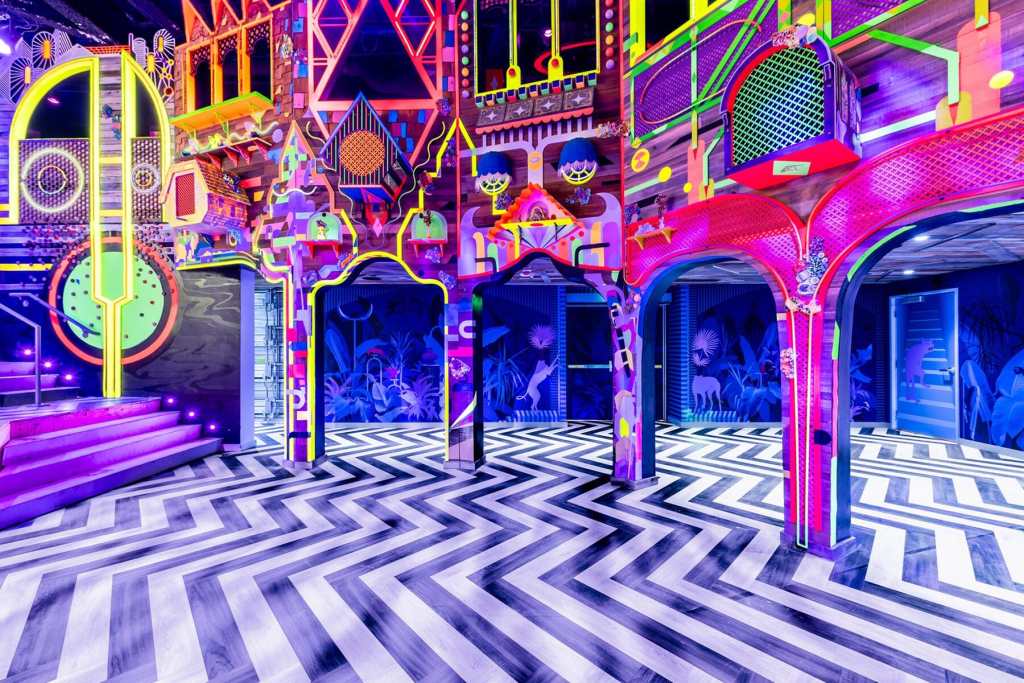
There is a moment, not long after you walk through the front door of an unassuming Victorian house on the edge of Santa Fe, when the house stops being a house. A refrigerator opens onto a glowing tunnel instead of a shelf of leftovers. A fireplace turns out to be a passage into a neon forest. What began as a slightly odd real-estate tour quietly becomes something closer to falling down a very well-funded rabbit hole, and by the time you notice it happening, there’s no obvious way back to where you started.
That house is the House of Eternal Return, the flagship installation of Meow Wolf, an arts collective that began as a scrappy group of Santa Fe artists and has since grown into one of the more genuinely strange success stories in contemporary American art. The premise on paper sounds almost too whimsical to work: a two-story suburban house, fully furnished, that visitors are invited to explore at their own pace — except that nearly every surface, appliance, and piece of furniture in it is a hidden doorway into an entirely different, non-Euclidean world.
A Mystery You’re Meant to Solve, or Ignore
Underneath the sensory overload, there’s an actual narrative. The Selig family, whose house this supposedly is, has mysteriously vanished, and scattered throughout the space are journals, letters, computer files, and objects that hint at what happened to them — something involving a rift between dimensions that the family appears to have discovered, and possibly been consumed by. Dedicated visitors spend hours piecing together the mystery like an art-world escape room. Everyone else simply wanders from room to glowing room, climbing through a washing machine into a crystalline cave system or crawling through a fish tank into a bus interior suspended mid-collapse, without ever needing to know why any of it is happening.
This dual structure is a big part of why the House of Eternal Return has aged so well since opening in 2016. It rewards obsessive attention without punishing anyone who’d rather just wander. Families with young children tend to treat it as an elaborate, glowing playground; older visitors and art-world regulars pick apart the visual references and narrative clues; and almost everyone, regardless of intent, ends up somewhere in between the two.
More Than a Photo Backdrop
It would be easy for a space this visually dense to collapse into pure spectacle — a series of Instagram backdrops strung together with black light and glitter. Some rooms undeniably lean that way, and Meow Wolf has never pretended otherwise; part of its appeal is unapologetically maximalist. But the strongest sections of the house go further than that, using scale, sound design, and disorientation to produce something closer to genuine awe than novelty. A room that seems to breathe. A corridor that appears to extend further than the building’s actual footprint should allow. A soundscape that shifts subtly depending on which direction you walk. These aren’t just decorative flourishes; they’re doing real psychological work, nudging visitors out of the passive, screen-scrolling headspace most museums quietly compete against.
The collective behind it has since expanded to permanent locations in Las Vegas and Denver, each with its own separate mythology and set of installations, but the original Santa Fe house retains a scrappiness and intimacy the newer, larger locations don’t quite replicate — a sense that this was built by a specific group of specific artists with a specific, slightly unhinged vision, rather than a franchise formula being reapplied at scale.
Practical Notes
Plan for at least two hours, and longer if you’re inclined to actually chase the narrative rather than just wander. The house rewards a slower pace than most attractions of its kind — corners get missed easily, and some of the best details are tucked into spaces most visitors walk straight past. It’s family-friendly by design, though a handful of tighter, darker passages may not suit visitors with claustrophobia. Comfortable shoes are worth the trouble; there’s a fair amount of climbing, crawling, and improvised route-finding involved, in ways a typical museum simply doesn’t ask of you.